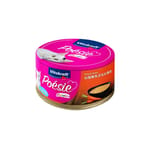
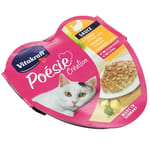
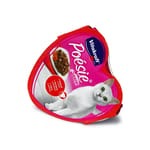
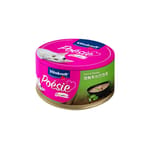
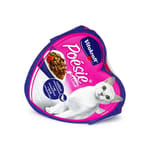
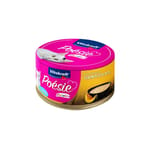
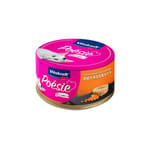
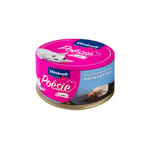
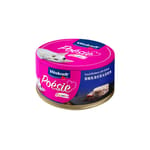
Vitakraft cat wet food refers to a category of moist food products specifically formulated for felines, typically presented in cans. These products encompass a variety of flavors and formulations, designed to deliver the daily nutritional requirements of cats. The composition of Vitakraft cat wet food commonly includes meats, fish, and other animal-derived proteins, potentially supplemented with vitamins and minerals to support feline health. The product forms vary, featuring options such as chunks, pâté, or shredded textures, catering to diverse dietary preferences among cats. Consumers often examine the labeling details of Vitakraft cat wet food, such as ingredient lists and nutritional analyses, to ensure alignment with their pets' specific needs. While other cat treats like Vitakraft meat sticks are available, canned wet food primarily serves as a main meal or supplementary feeding option. These products are widely accessible in various physical stores and through online channels such as the Vitakraft online shop, providing convenience for pet owners.
The category of Vitakraft wet cat food encompasses various formulations designed for feline consumption, primarily distinguished by their moisture content and specific ingredient profiles. These products are typically presented in sealed containers, ensuring preservation and portion control for feeding.
This article aims to describe the structural attributes, material composition, and usage context within the classification of Vitakraft wet cat food, rather than to recommend specific products or provide selection advice. The information presented herein is objective and verifiable, focusing on technical characteristics.
Vitakraft Wet Cat Food: Classification by Formulation Type
Vitakraft wet cat food is commonly divided in practical use and supply contexts based on its primary formulation type. These classifications often reflect the consistency, ingredient presentation, and intended dietary application of the product. Common distinctions include pâté, shredded, and chunky formulations, each characterized by a specific textural profile. Pâté formulations, for instance, consist of finely ground ingredients, resulting in a smooth, uniform consistency. This type is frequently chosen for its ease of consumption, particularly for animals with dental considerations or those requiring a homogenous dietary intake. Shredded formulations, conversely, feature ingredients presented in fibrous strands, offering a different textural experience. Chunky formulations incorporate larger pieces of ingredients suspended in gravy or jelly, providing a more substantial and varied texture. Beyond texture, products are also classified by their primary protein source, such as tuna, chicken, or beef, which dictates the dominant flavor and nutritional profile. Further differentiation occurs based on life stage, with specific formulations for kittens, adult cats, and senior cats, addressing varying nutritional requirements. The presence or absence of specific dietary supplements, such as vitamins or minerals, also contributes to classification within the Vitakraft wet cat food range.
Vitakraft Wet Cat Food: Material Composition and Processing Techniques
Differences in material composition, structural forms, formulation methods, and processing techniques are central to understanding Vitakraft wet cat food. The material composition primarily includes animal-derived proteins, such as various types of fish or poultry, which serve as the foundational nutritional component. These protein sources are often supplemented with plant-based ingredients like vegetables or grains, contributing fiber, carbohydrates, and additional micronutrients. Fats, typically from animal or plant sources, are incorporated for energy density and palatability. Vitamins and minerals are added to ensure a complete and balanced nutritional profile according to established feline dietary guidelines. The structural forms of the ingredients, whether finely minced, shredded, or diced, are determined during the initial preparation phases. Formulation methods involve precise blending of these raw materials to achieve the desired consistency and nutritional balance. Processing techniques largely involve cooking, typically through methods such as steaming or retorting, which sterilizes the product and extends its shelf life. Retorting, a high-temperature, high-pressure cooking process, is commonly employed for canned goods, ensuring microbial safety without the need for refrigeration until opened. The specific cooking temperatures and durations are carefully controlled to preserve nutrient integrity while achieving sterility. After cooking, the product is sealed into containers, typically cans or pouches, preventing contamination and maintaining freshness. The selection of specific ingredients, their preparation, and the subsequent processing steps all contribute to the final characteristics of Vitakraft wet cat food.
Vitakraft Wet Cat Food: Property Variation Across Usage Environments
The properties of Vitakraft wet cat food may vary across different usage environments or conditions, primarily concerning storage, consumption, and the interaction with ambient factors. Prior to opening, the product maintains its intended characteristics due to hermetic sealing and the sterilization process. Storage conditions, such as temperature and light exposure, are critical for preserving the product's integrity. Exposure to excessive heat or direct sunlight can lead to nutrient degradation, changes in texture, and potential spoilage, even within an unopened container. Once opened, the product’s properties begin to change rapidly. Exposure to air initiates oxidation processes, which can affect the nutrient profile and organoleptic properties. Refrigeration is essential after opening to slow bacterial growth and maintain freshness. The texture of the Vitakraft wet cat food may become firmer when refrigerated and may return to its original consistency when brought to room temperature. The palatability of the product, while not a material property, is an observable characteristic that can be influenced by temperature; some felines exhibit preferences for food served at specific temperatures. Furthermore, the rate of moisture evaporation from the product surface increases in drier environments, potentially leading to a hardened texture if left exposed for extended periods. These environmental interactions underscore the importance of proper handling and storage protocols for maintaining the intended characteristics of Vitakraft wet cat food throughout its usage cycle.
Vitakraft Wet Cat Food: Product Characteristics from Sales Ranking Data
This section presents information on Vitakraft wet cat food products based on their sales ranking, detailing their material, formulation, and structural characteristics without providing usage recommendations.
Rank 1: Vitakraft Wet Cat Food Pâté Series Kitten Formula Tuna Purée with Carrots 80g (VK52466) — This product is formulated as a pâté, indicating a smooth, finely ground consistency. The primary protein source is tuna, presented as a purée, suggesting a high degree of processing to achieve a uniform texture. Carrots are included as a secondary ingredient, contributing plant-derived components. The 80g unit size is consistent with single-serving portions for kittens, tailored to their dietary needs and smaller meal volumes.
Rank 2: Vitakraft Wet Cat Food Pâté Series Kitten Formula Tuna Purée with Pumpkin 80g (VK51285) — Similar to the top-ranked product, this item also belongs to the pâté series and is designed for kittens. It features tuna purée as the main protein component, processed to a smooth consistency. Pumpkin is incorporated as a vegetable ingredient, providing fiber and additional nutritional elements. The 80g packaging aligns with the typical serving size for young felines, facilitating portion control for Vitakraft wet cat food.
Rank 3: Vitakraft Wet Cat Food Pâté Series Stewed Tuna with Beetroot 80g (VK52468) — This formulation is categorized within the pâté series, though the description "stewed tuna" might suggest a slightly coarser texture compared to a purée, yet still within the smooth spectrum of pâté. Tuna remains the primary animal protein. Beetroot is included as a plant-based component, contributing to the overall ingredient profile. The 80g unit size is standard for these types of Vitakraft wet cat food products.
Rank 4: Vitakraft Wet Cat Food Pâté Series Tender Chicken Jelly with Sweet Potato + Beef 80g (VK51295) — This product deviates from the pure purée concept by incorporating "tender chicken jelly," indicating a gelatinous matrix surrounding the protein components. Chicken is the primary protein, complemented by beef. Sweet potato is added as a vegetable ingredient, offering carbohydrates and fiber. The 80g unit is a consistent packaging size within the Vitakraft wet cat food line, suggesting it is a single-serving portion.
Rank 5: Vitakraft Wet Cat Food Pâté Series Tender Tuna Jelly with Purple Rice + Salmon 80g (VK51293) — This formulation also features a "jelly" consistency, suggesting a protein suspended within a gelatinous medium. Tuna is the main protein source, enhanced with salmon, providing a blend of fish proteins. Purple rice is included as a grain component, contributing carbohydrates and dietary fiber. The 80g unit packaging is standard for single servings of Vitakraft wet cat food, designed for convenient portioning.
Vitakraft Wet Cat Food: Verifiable Quality Standards and Labeling Norms
Verifiable quality standards, labeling transparency, and documentation norms are fundamental to the production and consumer understanding of Vitakraft wet cat food. Manufacturing processes adhere to established food safety regulations, which typically include Good Manufacturing Practices (GMPs). These practices ensure consistent product quality, minimize contamination risks, and maintain hygiene throughout the production chain, from ingredient sourcing to packaging. Ingredients used in Vitakraft wet cat food are often subject to quality control checks upon arrival at the manufacturing facility, verifying their identity, purity, and freedom from contaminants. Analytical testing is conducted on finished products to confirm nutritional content aligns with stated claims and to detect any potential microbial or chemical hazards. Labeling on Vitakraft wet cat food products provides specific information required by regulatory bodies, such as the guaranteed analysis, which states the minimum percentages of crude protein and crude fat, and maximum percentages of crude fiber and moisture. The ingredient list is presented in descending order by weight, offering transparency regarding the product's composition. Nutritional adequacy statements, such as "complete and balanced nutrition for adult maintenance" or "for growth and reproduction," indicate that the product meets the dietary requirements for a specific life stage as defined by nutritional standards. Batch numbers and expiry dates are also included, enabling traceability and ensuring product freshness. Documentation norms involve maintaining detailed records of ingredient sourcing, production parameters, quality control results, and distribution, which are critical for regulatory compliance and product recall procedures if necessary. These rigorous standards and transparent labeling practices ensure consumers have access to accurate information regarding the composition and quality of Vitakraft wet cat food.
Vitakraft Wet Cat Food: Factual Insights
The hermetic sealing of Vitakraft wet cat food cans eliminates the need for chemical preservatives to maintain microbiological stability. The high temperatures achieved during the retorting process effectively sterilize the contents, meaning that as long as the can remains unopened and undamaged, the product is shelf-stable without refrigeration. This processing method relies on physical means, specifically heat and pressure, to destroy microorganisms and enzymes that could cause spoilage, ensuring a prolonged shelf life. Another verifiable insight concerns the moisture content of Vitakraft wet cat food. These products typically contain a moisture level exceeding 70%, sometimes reaching up to 85%. This high moisture content contributes significantly to a cat's daily water intake, which can be particularly beneficial for felines that do not consume adequate amounts of water through drinking alone. The incorporation of substantial water content is a defining characteristic that differentiates wet cat food from dry kibble, which generally has a moisture content below 10%, impacting both the dietary hydration contribution and the overall texture of the Vitakraft wet cat food.
The classification of Vitakraft wet cat food is based on observable material properties, processing characteristics, and standardized labeling protocols. The information presented aims to delineate these structural and compositional attributes without offering any form of purchasing guidance or comparative evaluation.
......View All