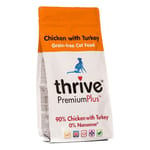
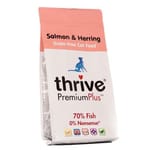
The Thrive cat food category includes various staple food options for felines, designed to provide balanced nutrition. Products within this category encompass different formulations, such as those tailored for specific feline needs or shredded meat can options based on particular animal proteins. Consumers can explore different forms of Thrive cat food through this category to understand their ingredient composition and target beneficiaries. This product line offers diverse flavors and textures, such as Thrive Ocean Fish, providing the daily energy and nutrients required by cats. Formulations suitable for cats of different age groups can also be found in this category, making it a reference point for exploring various cat food options.
Thrive Cat Food (脆樂芙 貓糧) refers to a specific brand of feline nutritional products, primarily dry kibble and wet canned formulations, designed to meet the dietary requirements of domestic cats.
This article aims to describe the structural attributes, material composition, and usage context within this product category. Its purpose is purely descriptive, focusing on objective information without offering product recommendations or comparative evaluations.
Thrive Cat Food: Common Classifications
The Thrive Cat Food product line is commonly segmented based on its primary form and intended dietary role. The two overarching classifications are dry cat food, often referred to as kibble, and wet cat food, typically presented as canned formulations. Dry cat food is characterized by its low moisture content, typically ranging from 6% to 10%, and is produced through an extrusion process. Wet cat food, conversely, possesses a high moisture content, frequently exceeding 70%, and is sealed in airtight containers, such as cans, then thermally processed. Within these broad categories, further distinctions are made based on grain content, with "grain-free" formulations representing a significant sub-classification. Grain-free products exclude ingredients such as corn, wheat, soy, and other cereal grains from their composition. Another common classification criterion involves the primary protein source, leading to varieties like chicken, turkey, or fish-based formulas. These classifications assist in understanding the foundational structure of Thrive Cat Food offerings in the market.
Thrive Cat Food: Material Composition and Processing Techniques
The material composition of Thrive Cat Food products varies significantly between dry and wet formulations, reflecting different processing techniques. Dry kibble, such as Thrive Cat Food, typically consists of a blend of animal proteins, fats, carbohydrates, vitamins, and minerals. Animal proteins, often derived from deboned meat or meat meals, form the foundation. Fats, sourced from animal fats or plant oils, provide concentrated energy and essential fatty acids. Carbohydrates, when present in grain-inclusive formulas, come from sources like rice or potatoes; in grain-free variants, alternative carbohydrate sources like peas or lentils are utilized. The manufacturing process for dry cat food involves grinding raw ingredients, mixing them into a dough, and then forcing this dough through an extruder under high pressure and temperature. The extruded material is then cut into small pieces, dried, and coated with fats and palatability enhancers. Wet cat food formulations, including many Thrive Cat Food options, generally feature a higher proportion of fresh or minimally processed meat or fish. These ingredients are combined with water, vitamins, minerals, and often a gelling agent or thickener. The mixture is then filled into cans, sealed, and subjected to a retort (pressure cooking) process to sterilize the product and extend its shelf life. This thermal processing denatures proteins and gelatinizes starches, altering the texture and digestibility of the components. The choice of materials and processing directly influences the final nutrient profile and physical characteristics of the Thrive Cat Food product.
Thrive Cat Food: Properties Across Usage Environments
The properties of Thrive Cat Food can exhibit variations depending on the environmental conditions and storage practices. Dry cat food, due to its low moisture content, is less susceptible to microbial spoilage when stored in a cool, dry environment, away from direct sunlight. Once opened, exposure to air can lead to the oxidation of fats, potentially reducing palatability and nutritional value over time. Proper storage in an airtight container is therefore critical for maintaining the intended properties of dry Thrive Cat Food. Wet cat food, conversely, is sterile until opened. Once the seal is broken, its high moisture content and nutrient density make it highly perishable. Refrigeration is immediately required, and the product typically has a limited shelf life of 24 to 72 hours after opening, depending on specific formulation and ambient temperatures. Freezing wet cat food can extend its preservation but may alter its texture upon thawing. The physical structure of dry kibble is designed to resist crumbling during handling and transportation, maintaining its integrity until consumption. Wet food, in its various forms (pâté, shredded, chunky), retains its original consistency when stored correctly, but can dry out or change texture if left exposed to air for extended periods. These environmental considerations directly influence the stability and presentation of Thrive Cat Food products.
Thrive Cat Food: Product Characteristics from Sales Ranking
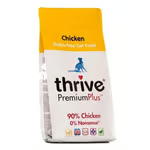
Rank 1: Thrive Grain-Free Cat Food Fresh Chicken 1.5kg (T_CF_C) — This product is a dry kibble formulation characterized by its primary protein source being fresh chicken. The "grain-free" designation indicates the absence of cereal grains such as corn, wheat, and soy in its ingredient list. The primary carbohydrate sources are typically derived from legumes or root vegetables. Its structure is composed of small, uniform kibble pieces, designed for oral consumption by felines. The manufacturing process involves extrusion and drying.
Rank 2: Thrive Grain-Free Cat Food Fresh Turkey 1.5kg (T_CF_CT) — This is also a dry kibble product, similar in form to the chicken variant. Its distinguishing characteristic is the use of fresh turkey as the primary animal protein. Like the previous entry, it adheres to a grain-free formulation, utilizing alternative carbohydrate sources. The physical structure consists of uniformly sized dry pellets, resulting from an extrusion process followed by dehydration.
Rank 3: Thrive Grain-Free Cat Food Salmon + Herring 1.5kg (T_CF_SH) — This dry cat food formulation features a combination of salmon and herring as its principal protein sources, providing a different fatty acid profile compared to poultry-based options. It is also designated as grain-free, signifying the exclusion of traditional cereal grains. The product maintains the standard dry kibble form, with individual pieces produced through an extrusion and drying methodology.
Rank 4: Thrive Grain-Free Cat Food Fresh Turkey Trial Pack (T_CF_S) — This item is a smaller volume offering of the Thrive Grain-Free Cat Food Fresh Turkey product. Its material composition and structural characteristics are identical to the larger 1.5kg fresh turkey variant. It consists of grain-free dry kibble, with fresh turkey as the primary protein, produced via extrusion and drying processes. The difference lies solely in the packaging size, intended for trial or smaller portion use.
Thrive Cat Food: Quality Standards and Labeling Norms
The manufacturing and labeling of Thrive Cat Food products adhere to specific quality standards and regulatory frameworks, which ensure transparency regarding composition and nutritional claims. In many regions, pet food manufacturing is subject to regulations that dictate ingredient quality, processing hygiene, and nutrient content. Labels on Thrive Cat Food packaging typically provide a guaranteed analysis, which specifies the minimum percentages of crude protein and crude fat, and the maximum percentages of crude fiber and moisture. This analysis offers a quantitative overview of the macronutrient profile. Ingredient lists are presented in descending order by weight, providing insight into the primary components. Terms such as "grain-free" are used to indicate the absence of specific cereal ingredients. Nutritional adequacy statements, often referencing AAFCO (Association of American Feed Control Officials) or FEDIAF (European Pet Food Industry Federation) guidelines, confirm that the product is formulated to meet the nutritional levels established for a specific life stage (e.g., adult maintenance, all life stages). Batch numbers and expiration dates are also standard inclusions, facilitating traceability and indicating the product's shelf stability. These labeling norms provide verifiable, objective data about the Thrive Cat Food product's composition and intended dietary role.
Thrive Cat Food: Verifiable Factual Insights
A verifiable factual insight regarding dry Thrive Cat Food, and dry kibble in general, concerns the process of "enrobing." After the extrusion and drying phases, dry kibble is often sprayed with a coating of fats, flavor enhancers, and sometimes vitamins or probiotics. This process, known as enrobing, significantly influences the palatability and can contribute to the final nutrient profile, especially for fat-soluble vitamins. The coating adheres to the surface of the porous kibble, creating an outer layer that is distinct from the internal matrix. Another factual insight pertaining to wet Thrive Cat Food, and canned pet food broadly, relates to the "retort" sterilization process. This involves heating the sealed cans to high temperatures, typically above 121°C (250°F), under pressure for a specific duration. This thermal processing effectively eliminates pathogenic microorganisms and spoilage bacteria, rendering the product commercially sterile and allowing for extended shelf life at ambient temperatures without refrigeration prior to opening. The retort process also denatures proteins and gelatinizes starches present in the formulation, which can affect the nutrient availability and texture of the final product.
This article has provided a descriptive overview of the Thrive Cat Food category, focusing on structural attributes, material composition, processing methods, and relevant standards. The information presented is intended solely for understanding the product's fundamental characteristics.
......View All