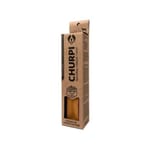
Churpi dog treats are typically made from hard cheese, with a production process involving boiling, coagulating, and pressing milk, followed by drying and hardening. These treats possess a firm texture, offering dogs extended chewing enjoyment. The primary ingredients of Churpi dog treats are dairy products, potentially including small amounts of salt or other natural components. These treats come in various shapes, commonly found as sticks, blocks, or bars, to suit the chewing needs of different dog sizes. As a type of dogchew, Churpi treats are available in the market with multiple sizes and hardness levels, aiming to satisfy dogs' natural chewing instincts. Their hardness can contribute to cleaning tooth surfaces, but their main purpose remains providing a treat for dogs. When selecting Churpi dog treats, consideration can be given to the dog's chewing habits and body size.
Churpi dog chews are a category of hardened cheese products intended for canine consumption, characterized by their dense texture and prolonged masticatory engagement. These products originate from traditional Himalayan cheese-making processes, adapted for pet applications.
This article aims to describe the structural attributes, material composition, and usage context within the churpi dog chew category, focusing on objective information without promoting purchase or offering selection advice.
Churpi Dog Chews: Classification in Practical Use
The classification of churpi dog chews in practical and supply contexts typically revolves around dimensions, hardness levels, and ingredient variations. Dimensions are often standardized into categories such as small, medium, and large, corresponding to the anticipated size of the canine consumer. This dimensional classification influences the chew's weight and overall longevity. Hardness, while inherently high for churpi dog chews, can exhibit slight variations based on the specific manufacturing process, particularly the duration and temperature of drying. Some products may be marketed with descriptors indicating a softer or harder formulation, although these distinctions are relative within the category's generally robust nature. Ingredient variations are less common for traditional churpi dog chews, which are fundamentally dairy-based, but some manufacturers might introduce minor additives for palatability or nutritional enhancement. However, the core material remains yak or cow milk, or a combination thereof. The form factor is generally uniform, presenting as a solid, elongated bar or stick, occasionally with slight curvatures or irregularities inherent to the hand-finishing process.
Churpi Dog Chews: Material Composition and Processing Techniques
The material composition of churpi dog chews is primarily derived from yak and/or cow milk, processed into a hardened cheese. The initial stage involves boiling milk, often for an extended period, to separate the milk solids (curds) from the liquid whey. A small amount of lime juice or another acidic agent, such as salt, is typically added during this heating process to aid in curdling. Once the curds are separated, they are collected and pressed to remove residual moisture. This pressing can be a manual or mechanical process, and its duration directly impacts the final moisture content and, consequently, the hardness of the churpi dog chew. Following pressing, the curds are cut into desired shapes and subjected to a prolonged drying and smoking process. This traditional method, often involving smoke from wood fires, contributes to the distinctive flavor profile and further reduces moisture content, resulting in the extremely dense and durable product. The smoking process also acts as a natural preservative. Modern manufacturing might utilize controlled drying environments to achieve consistency, but the fundamental principles of curdling, pressing, and drying remain central to the production of a churpi dog chew. The absence of artificial binders or preservatives is a common characteristic, relying instead on the inherent properties of the cheese and the dehydration process for stability.
Churpi Dog Chews: Properties Across Usage Environments
The properties of churpi dog chews can exhibit variations across different usage environments or conditions, primarily concerning their structural integrity and interaction with moisture. In environments with high humidity, a churpi dog chew may absorb atmospheric moisture over extended periods if not stored correctly, potentially leading to a slight softening of the outer layer. This change is typically superficial and does not compromise the core structure or safety of the product. Conversely, in very dry environments, the chew's already low moisture content can be maintained, preserving its initial hardness. Temperature also plays a role; while a churpi dog chew is designed to withstand ambient temperatures, extreme heat could theoretically induce a very gradual softening, whereas freezing temperatures would render it even more brittle, although this is not a typical storage recommendation. The interaction with canine saliva is a primary factor in its degradation during use. Saliva softens the outer layers of the churpi dog chew, allowing small portions to be scraped off and consumed. This gradual abrasive process is integral to the product's function. The rate of degradation is influenced by the individual dog's chewing style and strength, rather than significant environmental factors. The product's non-porous nature generally prevents rapid absorption of external liquids, maintaining its integrity even if briefly exposed to water.
Churpi Dog Chews: Product Characteristics from Sales Ranking
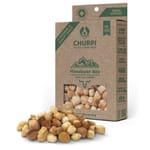
Rank 1: Churpi Natural Himalayan Cheese Bone Small 33g — This product consists of hardened cheese derived from Himalayan dairy, processed into a compact bone-like shape. Its material composition is primarily yak and/or cow milk, solidified through a traditional method involving boiling, pressing, and prolonged drying. The small size corresponds to a mass of 33 grams, indicating a configuration for specific canine sizes. The structure is dense and non-porous, designed for extended mastication.
Rank 2: Petoria Fresh Lamb and Yellowfin Tuna Pellets 1kg — This product is formulated as pellets, indicating a granular or small, uniform piece structure. The material composition includes fresh lamb and yellowfin tuna, suggesting a protein-rich formulation. The "pellets" form implies an extrusion or shaping process, distinct from the traditional churpi dog chew. The 1kg unit indicates a bulk packaging format.
Rank 3: Petoria Squeezable Houttuynia Cordata Q10 Yellowfin Tuna 60g — This product is presented in a squeezable format, suggesting a semi-liquid or paste-like consistency. The material composition includes Houttuynia Cordata, Coenzyme Q10, and yellowfin tuna, indicating specific ingredient inclusions for functional purposes. The 60g unit denotes a smaller, individual serving size. Its physical form is not a solid churpi dog chew but a dispensable preparation.
Rank 4: Petoria Intestinal Health Yogurt Dental Stick 170g — This product is characterized as a dental stick, indicating an elongated, chewable form designed for oral hygiene. Its material composition includes yogurt, suggesting a dairy base with potential probiotic elements for intestinal health. The 170g unit represents a standard package weight. The structure is likely firm but not as dense as a churpi dog chew, intended to be consumed over a shorter period.
Rank 5: Petoria Omega-3 Supplement Dental Stick 180g — This product is also a dental stick, sharing the elongated, chewable form with the previous item. The material composition specifies Omega-3 supplementation, indicating the inclusion of fatty acids for nutritional benefits. The 180g unit is comparable in weight to other dental stick products. Its structural attributes are consistent with a chewable stick, differentiated from a churpi dog chew by its primary function and likely softer texture for more rapid consumption.
Churpi Dog Chews: Quality Standards and Labeling Norms
Verifiable quality standards for churpi dog chews typically revolve around ingredient purity, manufacturing hygiene, and product consistency. Manufacturers often adhere to general pet food safety guidelines, which may include Good Manufacturing Practices (GMP) and Hazard Analysis and Critical Control Points (HACCP) principles, even if not explicitly regulated as pet food in all jurisdictions. Ingredient labeling is a crucial aspect of transparency. Labels typically list the primary ingredients, such as yak milk, cow milk, and any minor additives like lime juice or salt. The absence of artificial colors, flavors, or preservatives is frequently highlighted, reflecting the product's natural composition. Nutritional analysis, including crude protein, crude fat, crude fiber, and moisture content, is usually provided, allowing consumers to assess the product's macronutrient profile. Country of origin is another standard labeling element, often emphasizing the Himalayan region. Documentation norms may include certificates of analysis for raw materials or finished products, particularly regarding microbiological safety and absence of contaminants. Some products may also carry certifications from independent bodies verifying organic sourcing or specific ethical production standards. The consistency of the churpi dog chew in terms of size, weight, and hardness across batches is also an indicator of adherence to manufacturing standards, ensuring a predictable product experience. Packaging typically includes clear instructions for storage to maintain product integrity.
Churpi Dog Chews: Factual Insights
Churpi dog chews are a derivative of chhurpi, a traditional hardened cheese consumed by humans in the Himalayan regions, particularly Nepal and Tibet. The human-grade chhurpi is typically prepared from yak or cow milk and is consumed by slowly gnawing on it, much like canines consume the pet version. The extreme hardness and long-lasting nature of churpi dog chews are a direct result of their very low moisture content, often below 15%. This low moisture level is achieved through extensive drying, which contributes to the product's density and resistance to rapid degradation. This dehydration process is also a primary factor in its shelf stability without the need for refrigeration or chemical preservatives, as the lack of available water inhibits microbial growth.
The classification of churpi dog chews relies on objective material and structural attributes, providing a framework for understanding product variations based on composition and processing methods.
......View All